[Media Facade] Media Facade Cost: Five Things That Change the Quote
The cost of a media facade comes down to five things: the screen specification, the amount of content, the production method (2D, 3D or live action), the display hardware and whether it needs to be installed, and how long the facade will be operated afterwards. Two "one-minute videos" can be quoted very differently depending on these five conditions. If you sort them out before asking for a price, the quote comes back faster and closer to reality.
Why do studios give different answers on media facade cost?
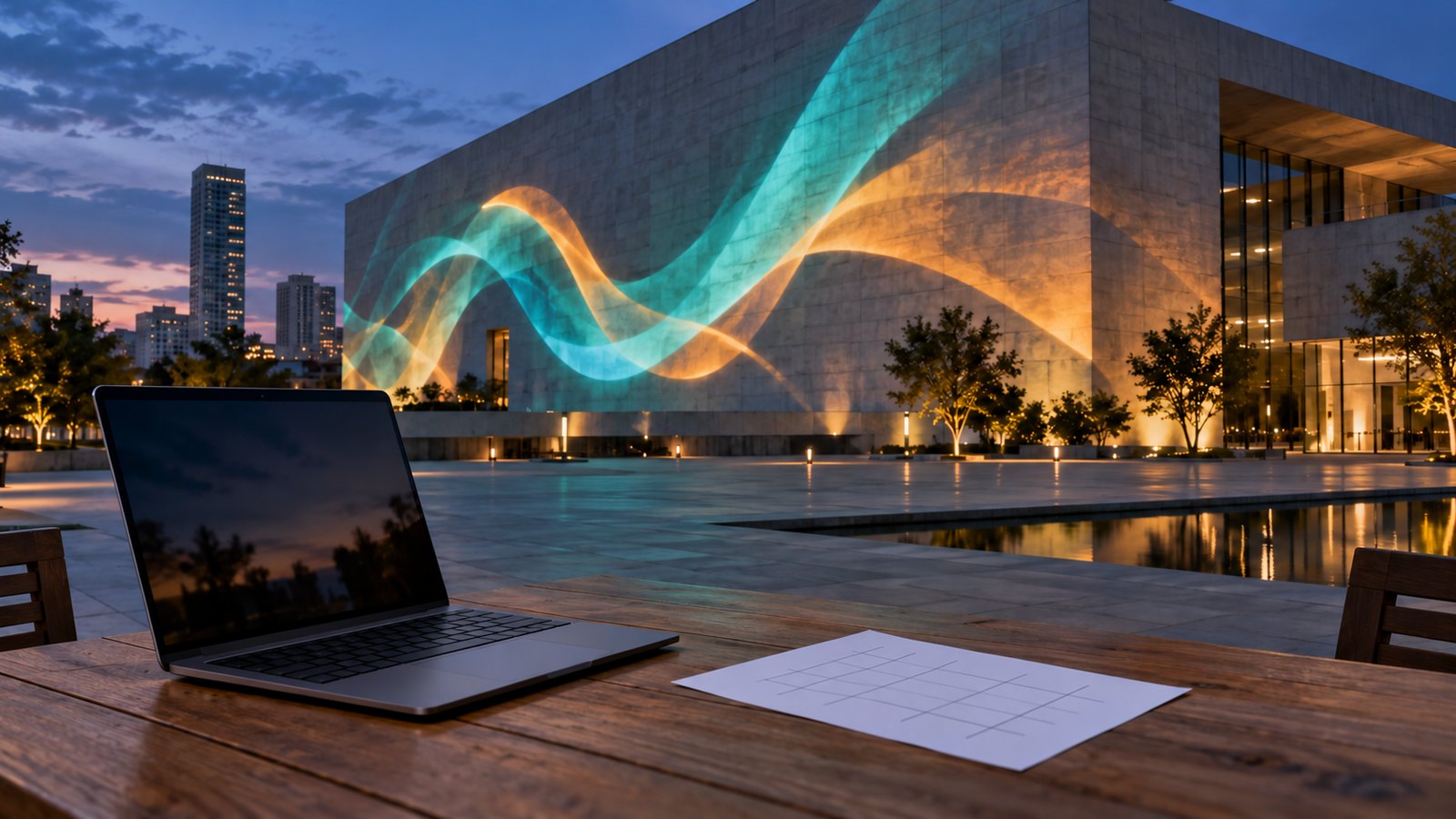
A media facade is not a standard product. It is built for one place at a time. Projection mapping across a whole building and an LED screen in an indoor lobby share the same name, but the work behind them is different. That is why "how much is a media facade?" has no single answer without conditions.
When you compare quotes, check what each one includes before you compare the totals. Content only, or hardware and installation too? Are content updates and maintenance after launch included? The same total can cover very different scopes. VisionPencil focuses on planning and producing the content. When LED hardware installation is needed, it is handled by Publicbloom (publicbloom.art), a sister company under the same CEO.
How do screen size and content length affect the cost?
The first variable is the screen. Higher resolution, unusual aspect ratios and multiple surfaces all add rendering and calibration time. A very wide facade, a screen that wraps around a corner, or a room where several walls must read as one image takes more work than a standard 16:9 display. We explain how to choose resolution in a separate article on media facade video resolution.
The second variable is length. More minutes and more pieces mean a longer production schedule. Because facades play on a loop, several short pieces in rotation often work better than one long film. Decide up front how many minutes, how many pieces and how many plays per day, and you avoid paying for content you do not need.
2D motion, 3D or anamorphic: what is the difference?
Production method moves the cost more than anything else. 2D motion graphics animate existing images and text, so they are relatively light. 3D adds modeling, materials, lighting and rendering. Anamorphic content is calculated so that it appears to pop out of the screen from one viewing point, which means it is designed for that single screen.
Two projects in our portfolio show the range. For the Buk-gu District Office anamorphic 3D billboard in Daegu, we modeled the district mascot and the Kyungpook National University mascot in 3D from scratch instead of reusing flat artwork. For the Jisan-dong Tumuli media facade in Goryeong, we created the Daegaya king and queen as 3D characters for a 1 minute 26 second photo-zone piece. Whether characters are built new or existing material is reused largely sets the scope. Live action adds a shoot day, equipment and casting.
Should hardware, installation and operation be in the quote?
If the screen is already installed, you only need a quote for content. If it is a new installation, the hardware is a separate line: LED or projector, indoor or outdoor, and whether a playback server and scheduling software are needed. For the Amnam Port media facade hall for Seo-gu District Office in Busan, we applied projection mapping in a bright second-floor space and set up a system that runs automatically on a fixed schedule.
The operating period is part of the cost too. Decide early whether content will change with seasons or events, whether there will be regular checks, and who responds when something goes wrong. We cover schedules, brightness and maintenance in our article on media facade operation.
What should you send when asking for a quote?
Send these five items and we can define the scope right away. One, screen size and resolution (if unknown, site photos and rough width and height). Two, the running time and number of pieces you have in mind. Three, your preferred direction, 2D, 3D or live action, or a reference video. Four, whether the hardware already exists or needs to be installed. Five, the launch date and how long the facade will run. For public projects, the project name and budget timeline help us plan the schedule.
FAQ
Roughly how much does a media facade cost?
It varies widely with screen specification, content length, production method, hardware installation and operating period, so we cannot give one number without conditions. Send us the five items above and we will quote for your conditions.
Can you make new content for an LED screen that is already installed?
Yes. Tell us the screen resolution, aspect ratio and the file format your playback system accepts, and we will produce content to that specification.
Do we need 3D or anamorphic content?
Not necessarily. Anamorphic works well where viewers stand in a fixed spot and grabbing attention matters most. If the goal is information or long loops, 2D motion graphics are often enough.
If you would like to talk through content for your site and screen, see our media facade page or send site photos through our contact page. We take inquiries in English.