[Media Art] Public Media Art: How to Make a Loop People Never Tire Of
Public media art is not watched once. The same people pass it every day, often many times. So the real test is not how striking it looks on day one, but whether it still feels comfortable after the hundredth viewing. At VisionPencil we work to a simple standard: slow transitions, colors toned down a step, a seamless loop where the end flows back into the beginning, and small variations hidden inside the repetition.
How is public media art different from an ad?
An ad has seconds to grab attention and leave a message. Media art in a city hall lobby, a plaza or a corridor is seen by staff on their way in, residents visiting for paperwork and people out for a walk. They see it every day.
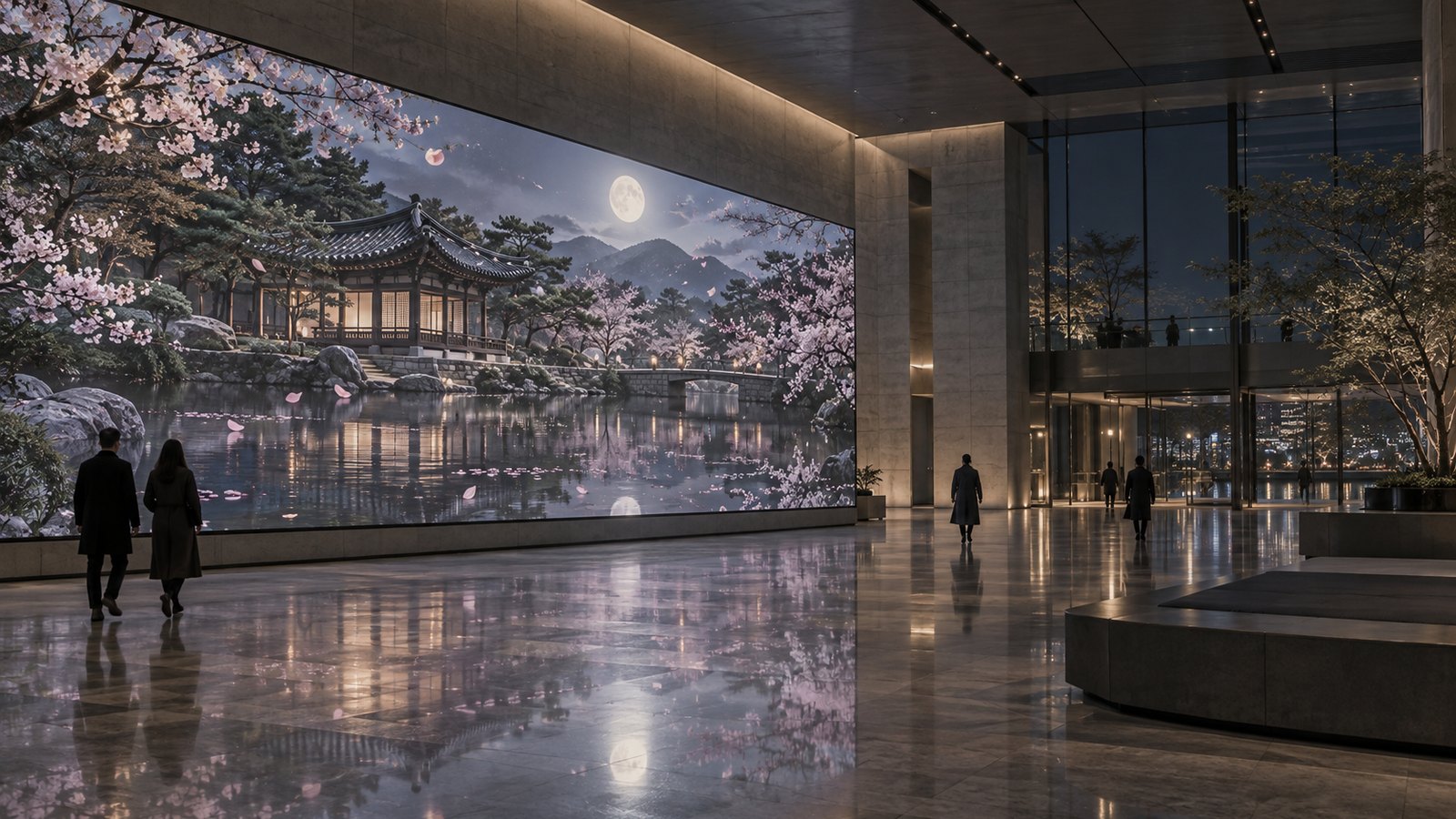
In that setting, fast cuts and loud primary colors stand out for a day and then become tiring. When we made a media art series for Buk-gu District Office in Daegu, our goal was quiet company rather than a strong message. The first piece, Whispers of the Sky, shows the moon, the night sky and a garden at midnight, with transitions deliberately slowed down. A piece that lets people pause and breathe fits a public space for longer.
How do you set color and pace?
Color should not feel heavy to anyone in the space. For the second piece in the series, Endless Flow, we lowered both saturation and brightness by a step. The aim was for the video to complete the space, not compete with it.
Pace depends on how people move through the site. In a lobby where people stop and wait, longer scenes work. In a corridor people walk through, the mood has to come across in a few seconds. Either way, it helps to avoid sudden changes where the whole screen switches at once. For screens seen at night, check brightness against the surroundings too. Too bright, and glare is what people remember.
The subject works best when it connects to the place. The third piece, Enchanted Garden, draws on the lines of a hanok (traditional Korean house) and the flowers of Korean gardens, with the colors of spring and autumn slowly crossing over. It focuses on subtle shifts of color and light rather than characters or a story.
How do you build a loop that plays all day?
Most public media art runs on repeat from opening to closing. Two things come first.
- A seamless loop: the last frame leads naturally into the first. If the screen fades to black and starts again, everyone notices the repeat.
- Variation inside the repeat: small changes are hidden in the sequence so that the piece feels slightly different each time. Endless Flow builds these into its cycles of repetition, expansion and contraction.
Real-time rendering takes this further. In an immersive LED room we built, the "Galaxy" space, the nebula and planet content repeats on a 30-minute cycle, but shader noise is used as a variable so the same scene never appears twice. Generative art approaches are especially useful for spaces that run for years.
What should you prepare before commissioning?
Planning moves faster when these are clear up front:
- Screen type (LED, projection, panels), size and, if possible, pixel count
- Location and viewer flow (do people stop here, or walk past?)
- Daily operating hours, and whether it runs by day, by night or both
- A theme tied to the place or organization (local landscape, seasons, history)
- Whether you want one piece, or a series you rotate over time
As with the Buk-gu project, a series rotated by season or period works well, and the benefit grows the longer the space is in use. You can see more projects in our portfolio and our media art on the art page. For LED and projection screen production in general, see our media facade production page.
FAQ
How long should a public media art video be?
There is no fixed length. It depends on how the screen runs and how people move past it. For a walk-through space, any short stretch should carry the mood. For a space where people linger, longer pacing works. Our immersive LED room runs on a 30-minute loop.
Won't people get tired of the same video?
That is why we build a seamless loop and hide small variations in the sequence. With real-time rendering, the flow can be different every time. Another option is a series of pieces rotated over time.
Do you make content for projection mapping or LED?
Both. Resolution, brightness and color behave differently on each, so the screen type should be fixed at the planning stage. If a screen is already installed, we produce to its specifications.
Tell us about your space and screen, and we will help you shape a media art direction that fits it. We work with clients outside Korea in English. Contact us