[Media Art] Lobby LED Walls: Choosing Content, Loop Length and Brightness
Content for a lobby or commercial LED wall should be chosen around one question: how long do people stay in front of it? If most people walk past, slow abstract work that looks complete at any moment fits best. If many people wait nearby, you can run pieces with a longer arc. Indoor brightness, a time-of-day rotation and a way for your own staff to swap content then decide whether the wall keeps working for years.
What kind of content suits a lobby LED wall?
Start with the space. A lobby is not a billboard. It is the first impression of the building. Promotional videos full of text and logos stand out for a moment, but for staff and tenants who walk the same route every day they quickly become noise. A good default is media art that sets the mood through color and motion, with brand messages added briefly and only when needed.
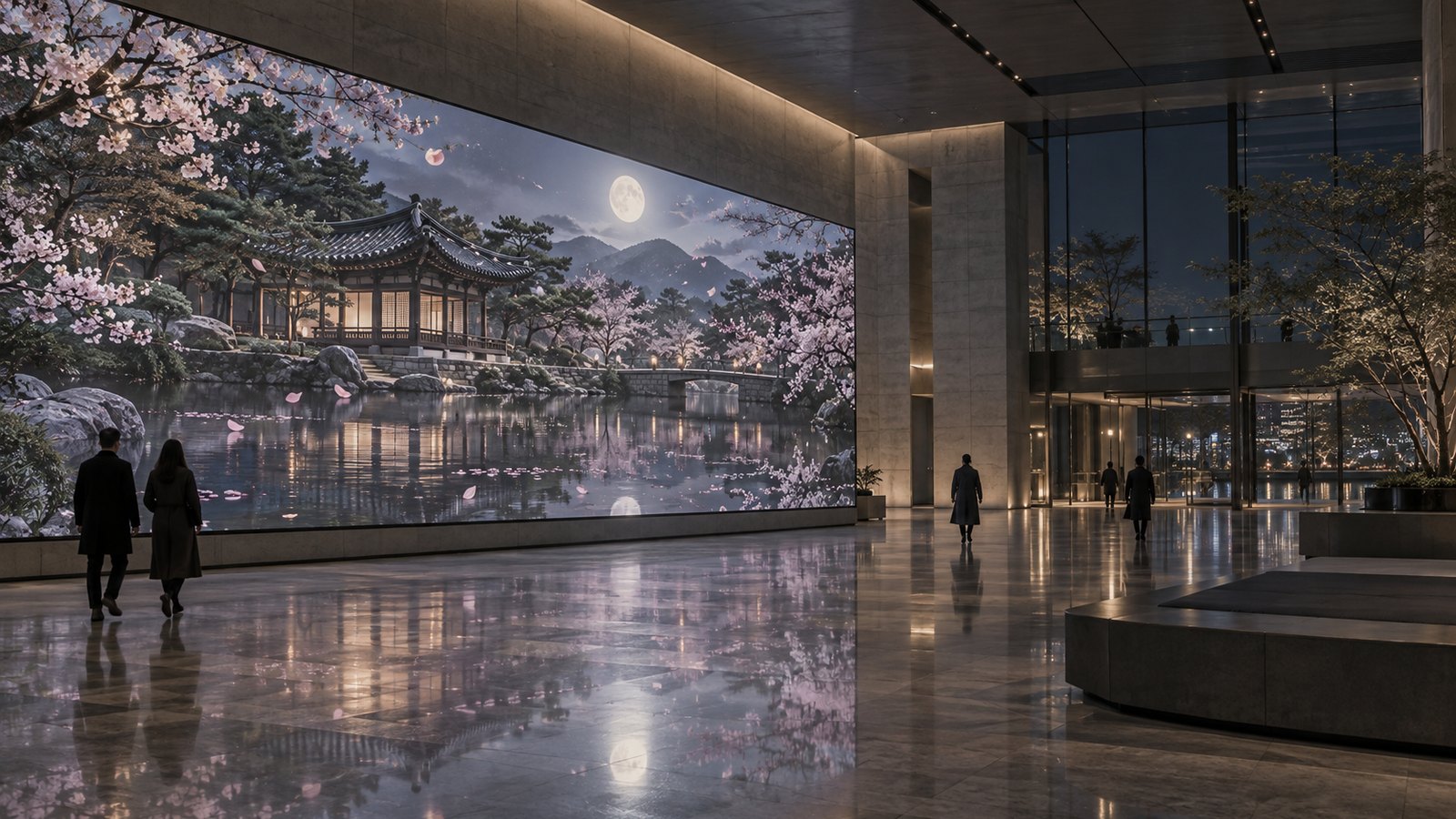
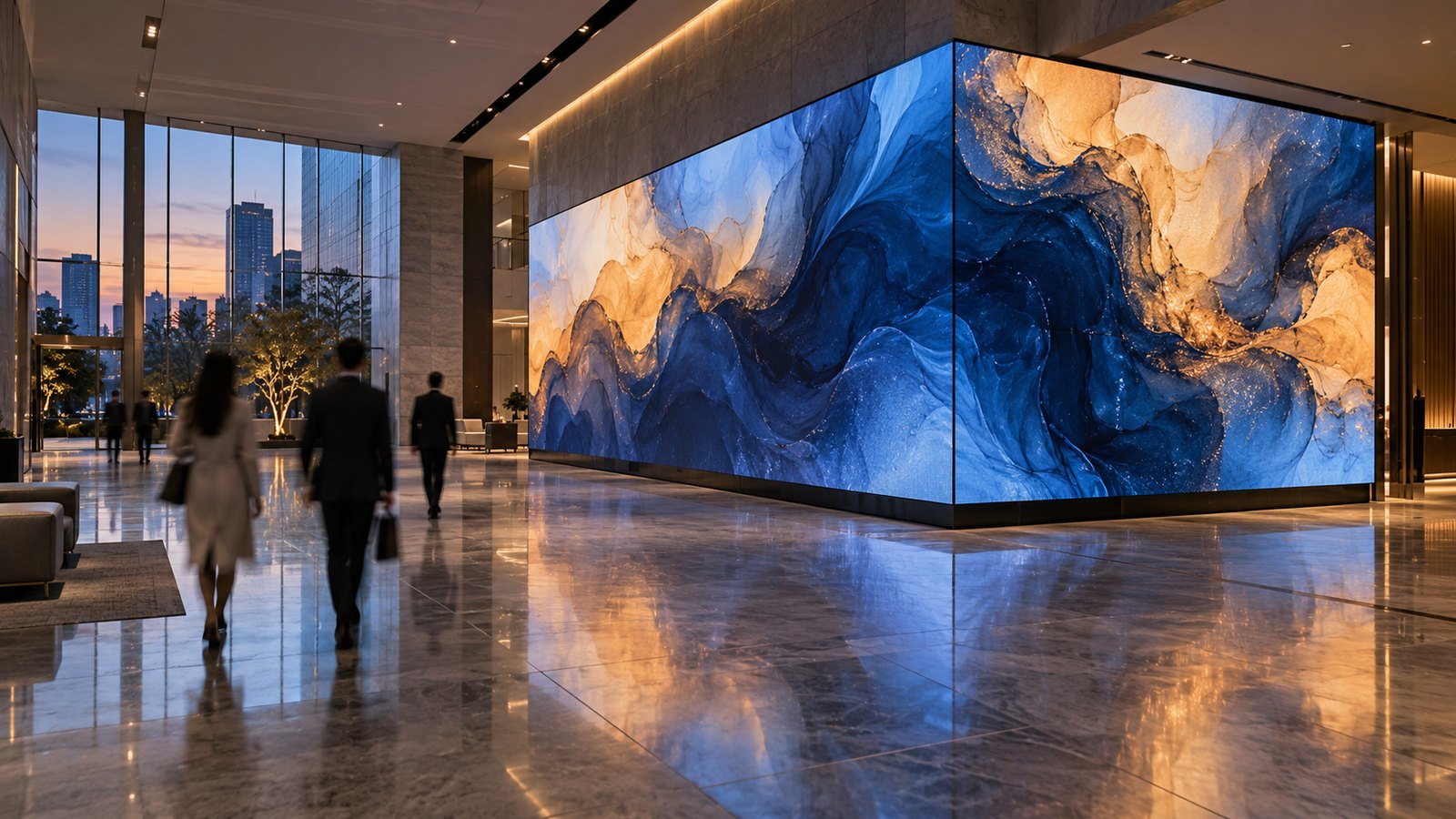
Our commercial corner LED wall project followed this approach. The large LED wall joins two faces of a lobby corner in a commercial building. We set it up to rotate, by time of day, a series of reinterpreted classic paintings and our own media art, matched to the brand tone. The intent was two layers: atmosphere for people passing through, and a deeper piece of art for people who pause. Thinking about these two audiences separately makes content choices much clearer.
If the wall wraps a corner or spans several faces, the content has to be made for that shape. Stretching a flat video across it bends the image at the corner or puts the main subject right on the seam. We treat the faces as one canvas and design key shapes to cross the corner naturally, at the wall's real aspect ratio, from the start.
How long should the loop be, compared with dwell time?
Dwell time is the reference. While someone waits for an elevator or stands at the front desk, a scene should not cut off abruptly. Someone who only glances for a few seconds should never land on an awkward frame. So transitions stay slow, and any frame should work as a still picture on its own.
The total loop length depends on how many times the same person passes each day. If they see the same scene at arrival, at lunch and on the way out, it wears thin fast. If a single piece cannot be made longer, rotate several pieces across the day. In our immersive LED room (galaxy space), nebula and planet content repeats in 30-minute cycles, but shader noise is used as a variable so the same scene never appears twice. Generative, real-time content is one way to reduce the sense of repetition without a longer file. We cover loop planning in more depth in our guide to public media art that holds up on repeat viewing.
How bright should an indoor LED wall be?
Run at full brightness, most indoor LED walls are too bright. People walk close by in a lobby, so glare is felt first, and reflections on stone floors and glass make the whole space feel restless. After installation we set brightness on site, checking day and night, with house lights on and off. In lobbies with large windows, the right level in daylight differs from the right level after dark, so scheduling brightness by time of day helps.
Content plays a part too. Scenes filled mostly with white or saturated primary colors feel heavy indoors. Darker backgrounds with light used only where it matters, or color and value pulled down one step, sit better in the room. Walls built from several faces or panels can differ slightly in color and brightness from face to face. As in the immersive room, pixel pitch correction and calibration are needed so the whole wall reads as one picture. Scheduling and maintenance are covered in our guide on operating a display after installation.
Who swaps the content, and how often?
An LED wall spends far more days in operation than in installation. If every seasonal change or event needs an outside vendor on site, updates get postponed and the same video runs for years. So the first design question is who will change the content.
For the commercial corner LED wall, we built a remote content management system after installation so the client can replace seasonal and event content themselves. The wall runs 24 hours a day, so stability came first, and over more than a year of operation both panels and content have run without interruption. Once a replacement cycle is set, content production can be planned. A practical setup is a few core media art pieces that always run, with seasonal or event content layered on top.
Before you request a quote, it helps to have the wall's horizontal and vertical resolution, the number of faces and how they join, operating hours, and the person who will manage content. For resolution, see how to decide media facade video resolution. Installed walls and content examples are in our portfolio and on our media art page.
FAQ
Can you make content for an LED wall that is already installed?
Yes. Send us the wall's resolution, face layout and playback hardware and we will produce to that spec. Site photos or drawings let us check corner and seam positions in advance, which makes the result more precise.
Can our company logo appear in the lobby content?
It can. Kept on screen all the time, though, it tends to feel like advertising. We usually suggest a short appearance within the loop, or carrying the brand through the colors and forms of the artwork itself.
Is it fine to run the same media art piece for years?
It will play, but people who pass daily get used to it. Rotating a few core pieces by time of day and adding seasonal or event content on a regular schedule keeps the same wall looking fresh.
If you are planning content for a lobby or commercial LED wall, send us the LED specs and photos of the space through our contact page. We work with clients outside Korea and reply in English.